Public Health · By the Numbers
What radon mitigation actually costs.
A radon mitigation system runs $800–$2,500 installed, with ~$1,500 the most common price. Real contractor pricing, measured radon levels for every U.S. county, and a ZIP lookup that shows your actual number — no email, no slop.
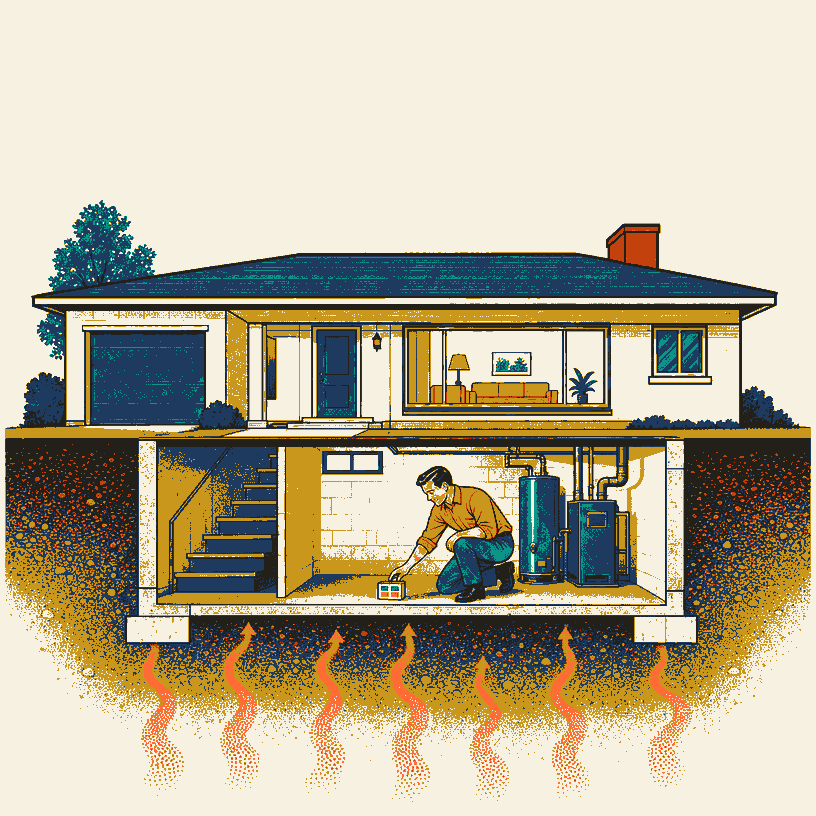
Radon mitigation is the process of lowering the radioactive gas that seeps from soil into homes, and for the overwhelming majority of houses it’s a one-day job with a predictable price. The national range is $800 to $2,500, and the number that matters most — the price a typical single-family home with a basement actually pays — sits right around $1,500. That figure has been remarkably stable for years, because the core system hasn’t changed: a fan, a pipe, and a hole in the right place.
What makes one quote $900 and another $2,400 usually isn’t the contractor being greedy — it’s the house. A single poured-concrete basement slab is the cheapest thing in the world to depressurize. A home with a crawlspace, a hollow block-wall foundation, an addition on a different footing, or unusually high starting levels needs more work, more pipe, and sometimes more than one suction point. The tables and guides below break that down so you can tell which situation you’re in before a salesperson tells you.
One thing to get straight up front: a low price is only a good price if the job is done right. The single most common way to make radon mitigation “cheap” is to skip the post-install re-test — the measurement that proves your level actually dropped. A system with no re-test is a fan on a wall and a hope. Everything on this site is built to help you pay a fair price for a system that works, not the lowest price for one that might not.
Radon mitigation cost by system type
The price depends mostly on your foundation. Here’s what each kind of system typically costs, installed.
| System | Typical cost |
|---|---|
Active sub-slab depressurization (ASD) The standard system, 90%+ of installs | $800–$2,500 |
Passive-piping activation Newer homes with a stack already roughed in — just add a fan | $500–$800 |
Crawlspace (vapor barrier + suction) Sealed membrane tied into the system | $1,500–$4,000 |
Block-wall depressurization Hollow-block foundations, a specialty install | $1,500–$4,500 |
Each additional suction point Larger or compartmentalized foundations | +$300–$500 |
Ranges reflect real contractor and state-program pricing; see our methodology on how we source cost data.
How radon mitigation works — and why it costs what it does
More than nine in ten radon systems are the same design: active sub-slab depressurization, or ASD. A radon fan — mounted in the attic or on an outside wall, never in the living space — runs continuously and pulls air out from under your foundation slab through a run of PVC pipe, venting it above the roofline before the radon can rise into the house. It works by turning the pressure under your slab slightly negative, so soil gas gets sucked into the pipe instead of drifting up through cracks. A single suction point handles most homes; when the fan is sized right and the slab is sealed, a good system cuts indoor radon by 90% or more.
That’s why the price is what it is. You’re paying for a specialized fan built to run 24/7 for years, the pipe and labor to route it cleanly to the roof, the sealing that makes the suction effective, and the diagnostic skill to put the suction point in the right place. The fan itself sips electricity — roughly a lightbulb’s worth, on the order of $70–$120 a year — and typically lasts 5 to 10 years before it needs replacing, a $150–$400 job when it does. Ongoing cost is minimal; the install is where the money is.
What moves the price up or down
Pushes it up
- Crawlspaces, block-wall, or mixed foundations
- Multiple suction points (bigger footprints)
- High starting levels needing a stronger fan
- Higher-labor metros and strict-licensing states
Pulls it down
- Passive radon piping already in the home
- A single, accessible poured-basement slab
- Competitive local markets
- Townhomes and smaller footprints
How to read a radon mitigation quote
Two quotes at the same dollar figure can describe two very different jobs. A complete, trustworthy radon mitigation quote should spell out five things: the system design (how many suction points, where the fan mounts, where it discharges), the specific fan model, the sealing work included (slab cracks, the sump pit, foundation penetrations), a post-install re-test to confirm the level dropped below 4 pCi/L, and a written guarantee tied to that result. If any of those is missing, that’s where the savings in a suspiciously cheap quote are usually coming from.
The credential to demand depends on where you live, and it varies more than people expect. Some states — Pennsylvania, Minnesota, Ohio — legally require a state license to do radon work, and an installer without one is working illegally. Others — Michigan, Utah — don’t regulate the trade at all, which puts the entire burden of vetting on you and makes independent NRPP or NRSB certification the only real safeguard. Our state guides tell you exactly which kind of state you’re in and what to verify.
Radon mitigation cost by state
State rules and prices vary — some states legally require a licensed installer, others don’t regulate the trade at all. Start with your state:
More states coming. See radon levels for all 47 states with data →
Don’t know your number yet?
Before you price a system, find out if you have a problem. Look up how radon tests in your county, then test your own home — the only way to know for sure. We’ll help you read the result.
Check your county →Is radon mitigation worth the cost?
Set against what it prevents, a ~$1,500 system is one of the better-value repairs a homeowner can make. Radon is the leading cause of lung cancer among people who have never smoked, and the second-leading cause overall behind smoking; the EPA attributes roughly 21,000 lung-cancer deaths a year in the U.S. to it. Unlike most home hazards, it’s invisible and cumulative — there’s no smell, no symptom, just years of exposure — which is exactly why a one-time fix for a permanent problem is such a reasonable trade.
There’s a financial case too. In most of the country radon is now a routine part of the home-inspection period, and an unresolved high reading regularly turns into a price negotiation or a stalled sale. A documented system with a passing re-test flips radon from a liability at the closing table into a checked box — often recovering much of its cost when you sell, on top of the health benefit while you live there. For the roughly half of homes in the highest-radon states that test high, it’s closer to routine maintenance than a rare emergency.
Health figures: U.S. EPA, Health Risk of Radon.
Radon mitigation cost FAQ
- How much does radon mitigation cost?
- A standard active sub-slab depressurization system runs $800–$2,500 installed nationwide, with about $1,500 the most common all-in price for a typical home with a basement. Crawlspaces, block-wall foundations, and multiple suction points push the price higher; a newer home with passive radon piping already installed can be activated for as little as $500–$800.
- What am I actually paying for?
- A radon fan mounted in the attic or on an exterior wall, PVC pipe running from under your foundation to above the roofline, sealing of slab penetrations and the sump, a manometer gauge, and — the part that matters most — a post-install re-test proving your level dropped below the action level. The fan runs continuously on about a lightbulb's worth of electricity.
- Does mitigation cost vary by state?
- Yes, meaningfully. State licensing rules, labor rates, and construction styles all move the price. Minnesota (strict licensing, cold-climate builds) runs higher; Ohio and Michigan sit lower. We publish state-by-state cost guides with the local rules and prices.
- How do I know if I even need mitigation?
- Test first. A lab-grade short-term charcoal kit runs about $15–$30 retail (shipping and analysis included) and gives you a real number. If it comes back at or above 4 pCi/L (the EPA action level), mitigation is recommended. You can also look up how homes test in your county to gauge your risk before you test.
- Is a radon system worth the cost?
- For most homeowners, yes. Radon is the leading cause of lung cancer among people who never smoked, and the EPA attributes about 21,000 lung-cancer deaths a year to it. A one-time system is modest insurance — and a documented, re-tested system removes radon as a sticking point when you sell.